Piezo vs. Magnetic vs. K&K vs. Internal Mic
You spent good money on an acoustic guitar that sounds incredible sitting in your living room. The low end is warm, the top has that nice woody response, and every chord feels full and alive.
Then you take it to a gig, plug directly into the PA, hit the first chord and wonder where your acoustic guitar went.
Suddenly it sounds bright, thin, harsh or almost plastic.
That difference usually comes down to one thing: how your acoustic guitar pickup is actually capturing the instrument.
Not every acoustic guitar pickup listens to the same part of the guitar. Some react primarily to pressure underneath the saddle. Others sense the vibration of the bridge plate. Magnetic pickups follow the movement of the strings. Internal microphone systems actually capture more of the air and resonance happening inside the instrument.
That means choosing the best acoustic guitar pickup is not really about finding one system that beats everything else. It is about finding the pickup that works best for your guitar, your playing style and the stage you are playing on.
Let’s break down four of the most common options.
Under-Saddle Piezo Pickups: Reliable, Loud and Stage Friendly
The under-saddle piezo is one of the most common acoustic guitar pickup designs, especially in factory-equipped acoustic-electric guitars.
As the name suggests, the pickup element sits underneath the guitar’s saddle. String vibration and pressure are transferred through the saddle into the pickup, where that mechanical energy is converted into an electrical signal.
There is a good reason these systems are everywhere.
They work.
Under-saddle pickups are generally reliable, consistent and capable of handling relatively loud stage volumes. If you are playing with a drummer, bass amp, monitors and electric guitars, that can be a huge advantage.
They also tend to cut through a mix extremely well.
The downside is that an under-saddle pickup is not hearing your guitar in the same way your ears hear it acoustically.
Your ears hear the spruce, mahogany, rosewood or other tonewoods interacting with the strings, body and air inside the guitar. An under-saddle system is much more directly focused on what is happening at the saddle.
That can create the sharp attack guitar players often describe as piezo quack.
The initial pick attack may become more prominent than the warm bloom of the guitar body. The result can sometimes sound brittle or overly direct compared with the unplugged instrument.
Modern preamps, EQ, impulse responses and better pickup designs can improve that dramatically, but the underlying character of an undersaddle pickup is still something to consider.
Who Should Use an Under-Saddle Pickup?
If you regularly play with a full band, need strong feedback resistance or simply want a dependable plug-in-and-go setup, an under-saddle system can make a lot of sense.
For many working musicians, reliability on stage matters more than perfectly recreating the sound of an acoustic guitar sitting three feet in front of a studio microphone.
K&K Pure Mini: Capturing More of the Guitar Itself
One of our favorite acoustic pickup options at Tone Tailors is the K&K Pure Mini.
We install a lot of them because they offer a different approach than a traditional undersaddle system.
The Pure Mini uses three transducers mounted directly to the bridge plate inside a steel-string acoustic guitar. Instead of sitting underneath the saddle, these sensors capture vibration from the bridge plate and soundboard.
That location makes a noticeable difference.
You are getting more information about what the top of the guitar is actually doing, which can produce a warmer, fuller and more natural acoustic character.
Players often gravitate toward the Pure Mini when they want the plugged-in guitar to retain more of the woody personality they hear when playing unplugged.
Another huge advantage is simplicity.
The standard K&K Pure Mini is passive. There is no onboard 9-volt battery to replace and no large control panel that needs to be cut into the side of the guitar.
For someone with a particularly nice acoustic, vintage guitar or instrument they simply do not want heavily modified, that can be a major selling point.
Does the K&K Pure Mini Need a Preamp?
Not necessarily.
This is an important distinction.
The Pure Mini can be plugged directly into compatible acoustic amps, mixers and other equipment, and K&K specifically designs the system to function passively.
However, the input impedance of whatever you connect it to can have a significant effect on the sound.
K&K generally recommends an input in roughly the 500k to 1 megohm range for the Pure system. A dedicated acoustic preamp or DI can help provide the proper impedance while also giving you gain, EQ, phase control and other useful tools.
So while a preamp is not mandatory, pairing a K&K with a good acoustic preamp or DI can make your live rig much easier to control.
For solo performers, singer-songwriters, fingerstyle players, folk musicians and bluegrass players looking for a natural acoustic tone, this can be a killer combination.
Magnetic Soundhole Pickups: Great for Loud Stages
A magnetic soundhole pickup works much more like the pickup in an electric guitar.
The pickup sits in the soundhole and uses a magnetic field to detect the vibration of the guitar’s steel strings.
Because of that design, magnetic acoustic pickups require strings with a magnetic or ferrous component. They will not work like a normal magnetic pickup with traditional nylon strings.
The big benefit is stage control.
Magnetic soundhole pickups can work extremely well in loud environments and are generally very resistant to feedback compared with systems that capture more of the guitar body’s resonance.
They are also available in designs that require relatively little modification to the instrument. Some can be temporarily mounted with the cable running out of the soundhole, while cleaner permanent installations can route the connection through an endpin jack.
Tonally, magnetic pickups have their own personality.
You usually get a smooth attack, strong midrange and warm overall response, but you may lose some of the open top-end character and acoustic “air” you would hear through a microphone.
That is not automatically a bad thing.
If you are running your acoustic through delay, modulation, compression, overdrive or a larger pedalboard, that slightly more controlled sound can actually be perfect.
Roots rock, Americana, blues and acoustic players working with effects can get some seriously cool sounds out of a magnetic system.
Internal Microphone and Blend Systems: Getting More Air and Detail
If your priority is reproducing more of the natural sound of the instrument, an internal microphone system deserves a serious look.
One popular example is the Baggs Anthem, formerly sold under the LR Baggs name.
And yes, that name change is recent.
In 2026, LR Baggs officially rebranded as simply Baggs as the company celebrated its 50th anniversary.
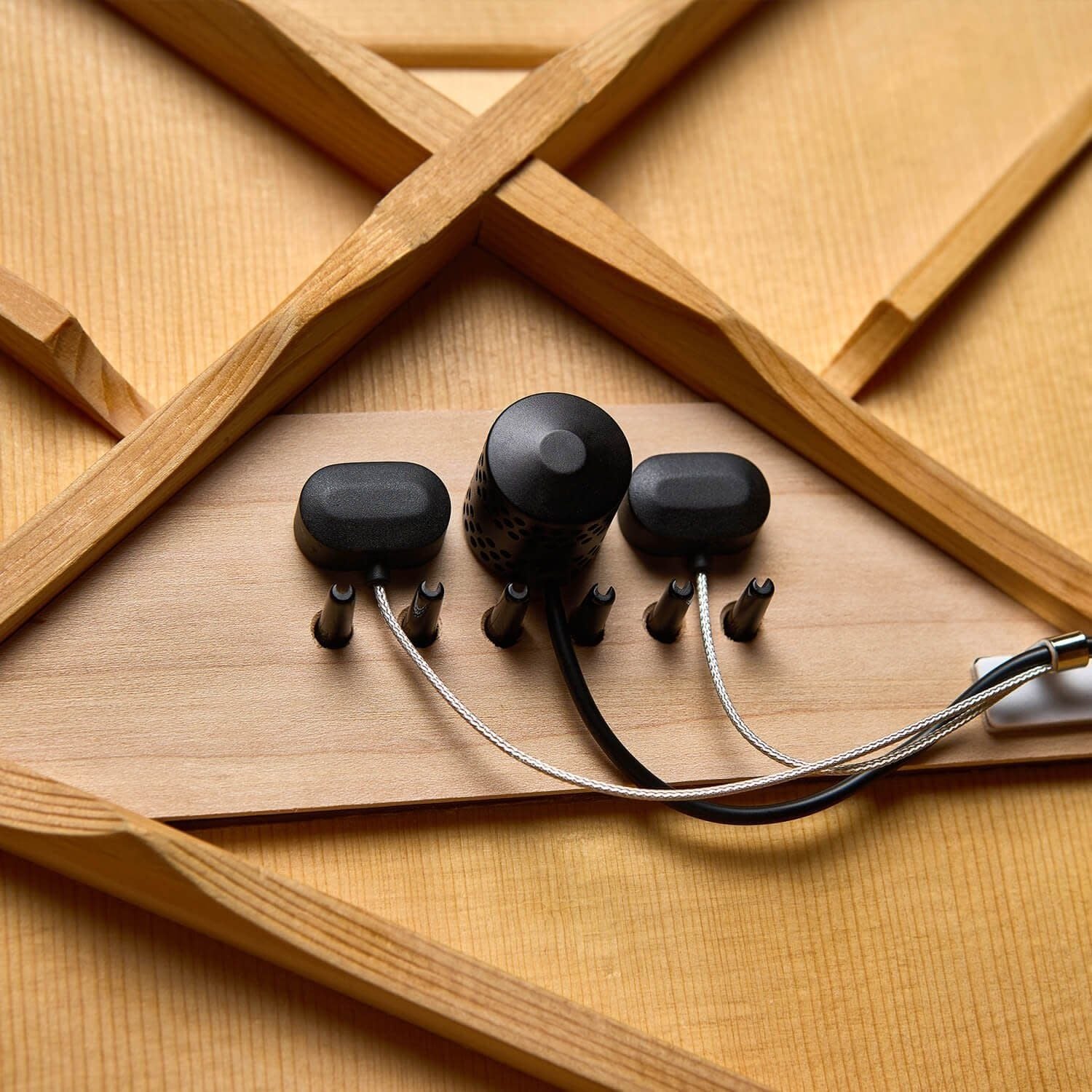
The Anthem combines Baggs’ Element undersaddle pickup with its TRU•MIC internal microphone technology.
Rather than asking the microphone to handle absolutely everything, the system divides the workload. The Element pickup handles the lowest frequencies while the TRU•MIC carries most of the remaining frequency range.
That gives you more of the air, body resonance and detail associated with an actual microphone while maintaining the stability needed for live performance.
You can then adjust the blend depending on your situation.
Playing a quieter solo show? Bring more of that microphone character into the signal.
Walking onto a louder stage where feedback becomes a concern? You have more control over how the system behaves.
No internal microphone is completely immune to feedback. Any microphone inside an acoustic instrument can react to stage volume, monitors and other instruments around it.
But modern systems like the Anthem are specifically engineered to make microphone-based acoustic amplification much more practical on stage.
Which Acoustic Guitar Pickup Is Best?
There is no single best acoustic guitar pickup for every musician.
The right answer depends on what you are trying to accomplish.
| Pickup Type | Best For | Main Advantage | Main Tradeoff |
|---|---|---|---|
| Under-Saddle Piezo | Full bands, loud stages | Strong output and feedback resistance | Can sound direct or “quacky” |
| K&K Pure Mini | Singer-songwriters, fingerstyle, folk, bluegrass | Warm, natural bridge plate response | May benefit from impedance-matched preamp or DI |
| Magnetic Soundhole | Loud bands, roots rock, effects users | Feedback resistance and smooth tone | Less acoustic air and body detail |
| Internal Mic/Blend | Players chasing maximum acoustic realism | More air, resonance and microphone character | More sensitive to stage conditions |
Think about where you actually play.
A beautiful microphone-heavy system might sound unbelievable by itself, but if you are standing two feet from a drummer every Saturday night, maximum realism may not be your biggest problem.
Likewise, the most feedback-resistant pickup in the world is not necessarily the right choice for a fingerstyle guitarist playing quiet rooms where every tiny detail matters.
Your playing environment should be part of the pickup decision.
What About Acoustic Guitar Feedback?
Feedback happens when amplified sound from the speakers excites resonances in the guitar and creates a loop between the instrument and sound system.
Acoustic guitars are especially susceptible because the entire instrument is designed to resonate.
That is great when you are sitting on the couch.
It can become a problem when you put a monitor directly in front of the guitar and start turning everything up.
Pickup choice helps, but it is only part of the solution.
Speaker placement, stage volume, EQ, phase controls, notch filters and soundhole feedback suppressors can all help control feedback.
This is also one reason a quality acoustic DI or preamp can be worth adding to your rig even if your pickup does not technically require one.
Can You Install an Acoustic Pickup in a Guitar That Does Not Have Electronics?
Absolutely.
You do not have to buy a factory acoustic-electric guitar just because you plan to perform live.
In many cases, adding the right aftermarket acoustic guitar pickup to an instrument you already love is the better move.
The important part is choosing a pickup that works with the instrument and having it installed correctly.
Undersaddle systems require extremely precise saddle and pickup contact. Bridge plate transducers need proper placement. Internal microphones need to be positioned correctly. Permanent magnetic pickup installations may involve installing or modifying an endpin jack.
Small installation details can make a huge difference in volume, string balance and tone.
Let Tone Tailors Help You Choose the Right Acoustic Guitar Pickup
There is a reason we do not automatically recommend the exact same acoustic guitar pickup to every player who walks into Tone Tailors.
Your guitar matters.
Your playing style matters.
Your band matters.
And what you consider a “good acoustic tone” matters.
Some players want maximum natural woodiness. Others need something that can survive a loud stage every weekend without fighting feedback for the entire set. Some want a completely passive guitar with minimal electronics inside it. Others want onboard controls and as much flexibility as possible.
Bring your acoustic into Tone Tailors and talk with our team.
We can take a look at the instrument, talk about where and how you play, compare acoustic guitar pickup options and help determine which system makes sense before anything gets installed.
Because the goal is not just to make your acoustic guitar louder.
The goal is to plug it in and still recognize the guitar you fell in love with in the first place.
Frequently Asked Questions About Acoustic Guitar Pickups
What is the most natural-sounding acoustic guitar pickup?
Bridge plate transducers and microphone-based systems are often preferred by players chasing a natural acoustic sound because they capture more information from the vibrating guitar body. Systems such as the K&K Pure Mini and Baggs Anthem take different approaches to achieving that goal.
Why does my acoustic pickup sound harsh or quacky?
That sound is commonly associated with some under-saddle piezo systems. The pickup is reacting very directly to mechanical energy at the saddle, which can emphasize the initial attack of the note more than the resonance that develops through the guitar body.
Is a K&K Pure Mini active or passive?
The standard K&K Pure Mini is a passive bridge plate pickup and does not require an onboard battery.
Do I need a preamp with a K&K Pure Mini?
Not always. It can operate without one, but matching the pickup to an appropriate input impedance is important. A compatible acoustic preamp or DI can also provide useful gain, EQ, phase and feedback-control tools.
Are magnetic acoustic guitar pickups good for live performances?
Yes. Magnetic soundhole pickups are frequently used for live performance because they offer good feedback resistance and work especially well in louder stage environments.
Can a magnetic acoustic pickup work with nylon strings?
Generally, no. Traditional magnetic pickups require strings with ferrous material for the magnetic field to detect their movement. Nylon-string guitars typically require a different type of pickup system.
What acoustic guitar pickup is best for a loud band?
An under-saddle pickup or magnetic soundhole pickup is often a strong starting point for high-volume performances because both designs can offer good feedback resistance. The exact choice depends on the guitar, tone you want and the rest of your live rig.